Monday, March 11, 2013
Check Out My HIV Etiquette Series on Gay.net!
In the meantime, a series I've been writing for Gay.net has been pretty good. It's an advice column-style series of articles designed to assist HIV-negative people in learning how to navigate the social aspects of HIV. I will update this post with new links to new articles as they come along.
How to React When Your Crush Says He's HIV-Positive.
How to Respond When Your Friend Tests HIV-Positive.
How to Discuss Personal Health With HIV-poz Peeps
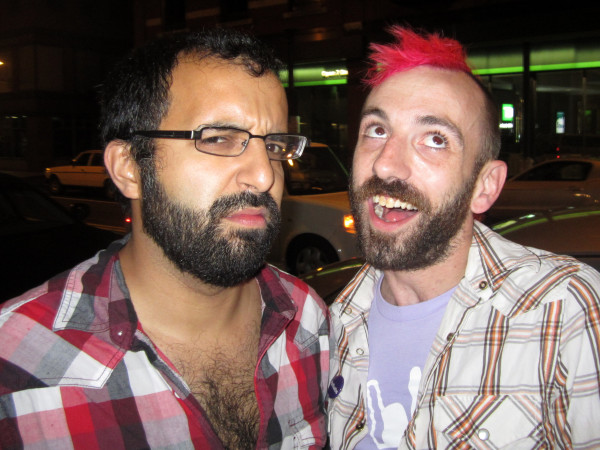
Also, here's a photo of me with my cat on my head.
Charity vs. Solidarity: Out of the Bathhouses, Into the Streets
While I have often received both criticism and approbation, both from the right and the left, for engaging in discourse on topics related to social justice, the core of the work that I do is driven by reasons not immediately apparent to many.
It is often self-evident to outsiders why I engage in the work I do. Few but the most deluded can ignore the systemic and institutionalized injustices in our society. Racism, economic disparity, sexism, homophobia... it’s all too clear that efforts need to be made in order to correct these ills. Capitalism, empire, and the state all work to oppress the working class and the policing of social movements warrants resistance.
One factor, however, to which little attention gets paid, is my personal motivation and inspiration for engaging in this sort of work. Far beyond the most obvious and superficial reasons-- I have been fired from the Armed Services for being queer, I have been homeless-- is a deeper connection to concepts that drive movements like the ones I have taken part in.
Social movements often stand in stark contrast to the narrative established by the ruling class, which states that social change and the betterment of our fellow humans is one that must come descended from a hierarchy of privilege. The wealthy and powerful would have us believe that justice must come from above; either charity from the rich or magnanimity from the state would grant us the resources or rights we desire and deserve. With recent studies indicating the wealthy donate little to charity and historical trends indicating the state is primarily being used to advance the agenda of the already-powerful, this is a narrative and idea that simply won’t do to correct the societal injustices of our nation and planet. What instead is needed is solidarity: where the oppressed, underprivileged, and poor stand together to demand change and the betterment of the social order in resistance to the goals and exploitation of the ruling class.
This concept first truly crystallized for me amidst a personal crisis of an extreme degree that I faced in my own personal exploits. While the example I outline below is but a microcosm of the concepts that I espouse previous, it illustrated to me quite neatly that charity, asking for help from those better off than I, is neither desirable nor effective.
In February, 2009, I moved from Eugene, OR a newly-diagnosed HIV-positive, unemployed 20-something with little in the way of goals or plans for the future. After spending close to a year working in a porn store, I secured a job at a local bathhouse located on Capitol Hill. I was making an hourly wage that wasn’t half bad, had a partner that I thought I was in love with, was accessing HIV treatment, and had a lovely apartment with a great view. Life was good.
The bathhouse proved to be my downfall, however. Much like many gay male-identified people, I had dabbled with hard drugs over the years. A brush with addiction to cocaine had been overcome some time previous, and an occasional brush with methamphetamine was not uncommon every few months or so.
This changed in the bathhouse. The Seattle gay sex club scene is rife with crystal meth use. This particular bathhouse even had someone living in one of the rooms full-time who made brisk trade selling meth to patrons. I, slowly, gradually, and finally explosively, became a full-time meth user.
This was undoubtedly the darkest time of my life. I stopped reliably taking my medications, to include both HIV and psychiatric medications. I have a small frame, and what little weight I had started to melt away. I stopped caring for my personal appearance, and my friendships with non-users started to suffer. My relationship became troubled, with my partner confused and baffled; a previously happy healthy Ian instead became angry, brooding, prone to explosive outbursts. I sometimes didn’t sleep for a week at a time. My job performance became erratic and spotty at best; I always showed up to work (where I could get the drug upon which I had come to depend), but the quality of my work suffered.
My life finally fell apart and I had no recourse but to admit I had a problem. My partner, finding out that I was using, left me. I lost my apartment. The only thing left I had was a job that enabled me to find and use the drug that was slowly killing me. When I became homeless, I too started living at the bathhouse, just up the stairs from the dealer that gave me the substance that was destroying my life. I took a step that was one of the harder things to do: I admitted I had a problem, publicly and openly, and sought treatment.
In the weeks between my admission and my registration at an inpatient addiction treatment facility, living at the bathhouse was clearly untenable with my goals of getting better. I had to seek out another place to stay; someplace where I would not use. I turned to my non-using friends to try and find housing; none of my calls, messages, emails were returned. Those best equipped to help me would not. I was left without any recourse.
Except, of course, from my fellow addicts. Many of them were years-long addicts, and while they still used and would not necessarily admit that they had problems, they recognized the deep and disturbing problems in their lives. They saw that I had made a choice to try and change, a choice that many of them desperately wanted for themselves in their own lives. In the end, the ones who took care of me and encouraged me most were those who were themselves in the thrall of addiction.
I lived, in those weeks, on an addict’s couch. One addict, as the weather was getting colder, made sure I had warm clothes. Several shared their groceries with me and made sure I ate. While they were not able to encourage me to quit my use immediately, they at least assisted me in my other material needs and sent me off to treatment with well-wishes and the hope that I would accomplish my goal, that of being meth-free.
This illustrated to me something crucial to gay meth culture in Seattle. While it was a seedy scene driven by sex, drugs, and the immediate gratification of baser instincts and wants, it was a cohesive, if dysfunctional, community. While infighting occurred, mostly squabbles over money and drugs, there was a sense of solidarity. We were all sick. We were all living in fear of getting caught by police. We were all in fear of overdose and death. So we helped each other to survive.
The juxtaposition of the reaction garnered from my non-using friends and those who shared my addiction is stark. I asked for charity from those best able to give it and it was denied; asking for help from those more materially privileged had been useless. However, when leaning on my fellow addicts, my needs were met and I was able to save my life.
This gave me an essential understanding of the concepts of charity and solidarity and has shaped a great deal of how I view the struggles of the working class and underprivileged. We can beg for scraps from a richer table and ask for charity, either in the form of resources or rights. This will likely lead to the failure of the working class and the continued oppression of the many peoples who find themselves the victim of white, capitalist, patriarchal exploitation.
It is instead in the solidarity and shared struggle of our fellows that we get by, and we must harness that in order to seize the needs for which the ruling class would have us petition, request, and beg. It won’t be until we break this paradigm of trickle-down justice that we more truly empower the disempowered in our own destiny.
I don’t pretend to say that my experience as an addict is a universal one, but it is indeed a small subsection of experience that informs a valuable praxis of political activity. I wonder what other stories are out there, other cultural experiences that fuel concepts such as mutualism and solidarity. As we enter into a new age of radical resurgence and political unrest, however, we would do well to remember: begging will get us nothing. We must provide for ourselves, and the only way we can do that is together.
Wednesday, January 30, 2013
Becoming Male (?)
Examining gender in oneself can be a tricky proposal, especially when one doesn’t choose to do so until later in life. As a 30-year-old individual who has always assumed the proper identification of their gender to be the same as their sex, my internalized feelings and suppositions about my gender have always been ones constrained by my understanding of society’s perception of my body and identity. I have lately found my feelings about my gender, however, to have recently shifted, and as I look over the course of the past three decades, I can see how it has evolved, unbeknownst to me, in a large part due to the intersectionality of patriarchy and my own sexuality in ways that have defined my identity without much thought or input of my own.
Gender is, of course, one of our attributes that are defined through a process sociologists refer to as “social identity development.” Through five stages, known as naivete, acceptance, resistance, redefinition, and internalization, we come to develop within ourselves classifications that some call necessary in order to integrate within society. Some statuses, such as agent statuses, may not require the completion of all stages. A white person, for example, may accept that they are white and then stop there; they do not need to be introspective as their privilege makes challenge unnecessary to gain membership into advantaged groups. As a male-bodied individual, I have this privilege and never stopped to challenge (or resist and redefine) assumptions about my gender, both on my part and on the part of those around me.
This privilege comes, of course, from patriarchy. In order to maintain supremacy within human societies, males have given special status and privilege to people who are male-bodied. This patriarchy problematically asserts that certain behaviors are appropriate for men and certain behaviors are appropriate for women, which serves to delegate the role of “woman” away from positions of power and prestige.
Patriarchy, however, does not just rule the world of the heterosexual. People who do not subscribe to the gender binary often fall victim to the ideation of the straight male when it comes to “male” and “female” behavior. The roots of homophobia are certainly found in misogyny, as men who have sex with men are denigrated through feminization and derogatory language; when we call queer men “sissy” or “bitch” we are calling them female and somehow this is seen negatively. The assumption that “female” behavior, such as submitting sexually to another man, is negative is one that not only disempowers men in their own identities but implies that women are inferior to men.
Growing up queer, I have of course experienced this. I have always had “effeminate” behaviors, and when I came out it was no surprise to anyone around me. This, of course, exposed me to sanctions from the society I live in, with my peers harassing me and the world at large seeking to assert the “rightness” of male behavior in male-bodied individuals. As part of my socialization process, I accepted this and strove to define myself as male with masculine characteristics. I have since realized that this does a disservice not just to myself but to others.
This was easily illustrated to me recently in a conversation I had with a friend. She loudly proclaimed that she hated all men; I feigned taking offense. She laughed, shook her head, and stated “Oh Ian! I don’t view you as a real man.”
This led to a whole host of ideas which pretty deeply challenged my assumptions. My concept of self, I realized, was predicated on patriarchy. Further introspection was needed. I began to resist my own idea of who I was, and at the age of thirty finally began to complete the social identity development process. I began to resist the concept of “male” as defined by society and started to redefine myself.
The problem, however, is that when we define ourselves we tend to place limitations on our role in society. I don’t feel female, and since I experience privilege as a male-bodied individual, it feels disrespectful to claim that term. Many of my characteristics are deemed “masculine” while some are judged “feminine.” So what am I? I have male sex parts and yet reject the supremacy of “male.” I feel feminine many times, but benefit from male privilege and act with male behaviors. So what do I call myself?
In the end I suppose I haven’t chosen to conform to anybody else’s definitions. I am not trans nor am I strictly male. I started telling people that they could refer to me either by “he” or by “they”. I have changed my gender identification slightly; I now include a (?) at the end of it. Male (?) perfectly describes, to me, my identity. Yes, I am male-bodied, and yes, I am perceived as male. However, there should be a little bit of mystery. It’s in that mystery that I can truly explore myself and internalize (or not) the conclusions I find. Perhaps through non-definition I can more truly define myself.
Tuesday, January 15, 2013
Get Your Priorities Queer: How Jodie Foster Ruins Everything
It's not Jodie Foster that ruins everything. It's our reaction to her that does. When I use the word "our," to whom do you think I refer?
I hope you guys weren't hoping this would be a big coming out speech tonight, because I already did my coming out about a thousand years ago, back in the stone age. In those very quaint days when a fragile young girl would open up to trusted friends and family, co-workers, and then gradually, proudly to everyone who knew her, to everyone she actually met. But now apparently, I'm told that every celebrity is expected to honor the details of their private life with a press conference, a fragrance, and a prime time reality show. You guys might be surprised, but I am not Honey Boo Boo Child. No, I'm sorry, that's just not me, it never was, and it never will be. But please don't cry, because my reality show would be so boring. I would have to make out with Marion Cotillard, I would have to spank Daniel Craig's bottom, you know, just to stay on the air. It's not bad work if you can get it though.
But seriously. If you had been a public figure from the time you were a toddler, if you'd had to fight for a life that felt real and honest and normal against all odds, then maybe you too might value privacy above all else. Privacy. Someday, in the future, people will look back and remember how beautiful it once was.
Some gave approbation at her admission, siding with Ms. Foster with pleas to have respect for her right to privacy:
Some will argue that visibility matters, and she should have come out earlier in order to serve as a role model. I say she’s served the LGBT community in her own way. In 1994, she was the first major donor to provide support for the production of the short film Trevor, about a teenager who attempts suicide after realizing he might be gay. The film won the Academy Award for Best Short Film (Live Action), and spurred the filmmakers to found The Trevor Project, now the leading national crisis intervention and suicide prevention service for LGBTQ youth. She did this in 1994, folks—long before LGBTQ youth suicide became a big issue in the national headlines in 2009-10 and other celebrities like Lady Gaga and Katy Perry added their voices. In 2007, Foster gave The Trevor Project the biggest donation in its history. Sure, national out visibility can be a good thing, but it’s not the only way to serve.Others were not as supportive of her decades-long silence, insisting that in current years it is the responsibility of gay celebrities to come out:
But whatever you thought of last night, you'd have to agree that it was another indication of how it's becoming harder and harder for anyone in public life to have any real credibility and still be living in the closet. Personally, I don't care if people like Jodie Foster are bitter or annoyed at activists. It's the job of activists to challenge people and, yes, to annoy people. What I care about is that the repressive and suffocating gay closet not be seen as a good place even if it is still the only safe choice for many. The only reason that millions are still in the closet is that society forces them there under threat of punishment. But things get easier for all those millions of closeted individuals when Hollywood celebrities and media figures come out. And more and more, it appears that it's becoming their responsibility, as privileged members of society, to do so.Some appeared to take her speech personally, and blew up in fury and outrage:
Why am I so angry? Because I'm roughly the same age as Jodie, and yet I had the courage to come out exactly 20 years ago. This was before Glee and Modern Family and Will & Grace -- and even Ellen DeGeneres' historical and culture-changing pronouncement. I, and so very many others, took a leap of faith and dealt with the consequences. Sure, I wasn't worried about losing $20 million a picture, but it's all relative: I feared that family and friends would abandon me, that I'd get passed over for jobs and promotions, that I'd be the victim of violence, and all the other clichés from the after-school specials.It's not just on Huffington Post and other public forums where these debates rage. I'm on a few listserves for LGBT bloggers and activists, and over the past two days I've had close to 100 e-mails land in my inbox with nothing but the phrase "Jodie Foster" in the subject line. Heated arguments have been exploding in the electronic back rooms of the publications LGBT Americans read, and I can't help but be appalled at the single-minded obsession with rehashing, yelling, and debating a less than 10-minute speech.
In fact, I would encourage my friends and colleagues to talk about... other things. Other more important things. Things that queer and transgender people face every day in our country and around the world.
Let's see what else has happened recently that seems to have fallen by the wayside among our prominent (and predominately gay) voices:
Back in August, a DC cop solicited a transwoman for sex and was refused. Drunk, he then angrily pulled his weapon and shot through the windshield of the car she and her four friends were in, endangering the lives of everyone inside the vehicle. He got off with probation, and while some in the community certainly voiced their outrage, it's confusing how Jodie Foster's speech is getting more attention than attempted murder by one of DC's "finest." I find this personally a lot more offensive than her angry on-stage rant. Guess how many e-mails I got about this in my inbox, by comparison. That's right, only 3.
There's no doubt that the online LGBT community has benefited from this man's work. Aaron Swartz, a computer programmer integral to the success of Reddit and other online communities, was also crucial to a movement in resistance to the passage of SOPA/PIPA. He was found dead after years of harassment from federal prosecutors accusing him of illegally disseminating copyrighted materials. His death has been ruled a suicide, and there is no doubt in the culpability of those prosecutors in his demise.
Did you know he was queer?
People shouldn’t be forced to categorize themselves as “gay,” “straight,” or “bi.” People are just people. Maybe you’re mostly attracted to men. Maybe you’re mostly attracted to women. Maybe you’re attracted to everyone. These are historical claims — not future predictions. If we truly want to expand the scope of human freedom, we should encourage people to date who they want; not just provide more categorical boxes for them to slot themselves into. A man who has mostly dated men should be just as welcome to date women as a woman who’s mostly dated men.
So that’s why I’m not gay. I hook up with people. I enjoy it. Sometimes they’re men, sometimes they’re women. I don’t see why it needs to be any more complicated than that.
I've written about CeCe and the prison industrial complex before, and while there are currently no new developments in her case, it's certainly a topic worth addressing with as much (and in fact more) fervor than Ms. Foster's sexuality. CeCe, imprisoned for defending her life from transphobic attackers, needs support. Not just in the form of legal support, but in the form of real, material support. She urges people to not just send letters to her, but to other trans prisoners, and cries out for the attention of the LGBT community in examining the plight of transfolk in the prison industrial complex.
Because really, who needs to be more visible. Foster? Or them?
Sunday, June 10, 2012
Radicalizing Netroots Part 2.
The next day started off with chuckles. Daniel introduced me to the most ridic spoof of Jem (remember? From the 80s?) on YouTube that could ever be made.
This, in fact, turned out to be the highlight of my day. After spending all day going to panels and trying to find fellow revolutionaries (and Tweeting an insane amount of Tweets about the Radicals' Caucus the next day) I headed out to a couple receptions (one of which was about marriage equality. I, while welcome, definitely drew some curious looks. Why was I there again? Oh yeah. Free booze) and then joined Joe Jervis and co. for the Providence JoeMyGod meetup. Hilarity and more drunkenness ensued.
The next day was definitely far more action-packed. We started off with the LGBT caucus, which invited a politician (no, I don't remember who, politicians kind of bore me) to speak. Note: "He has a 100% equality rating with the HRC!!!" isn't exactly a shining endorsement. We also received official White House copies of Barack Obama's pride proclamation.
Also, Zach Wahls, famed for his impassioned speech to the Iowa legislature on behalf of his two moms (and the most Tweeted about, swooned-over member of the LGBT caucus) called me a cutie pie.
We had our unofficial, unsponsored Radicals' Caucus, and I'm happy to report it went well. We started by identifying our key issues (police oppression, decolonization, anti-capitalist organizing) and then brainstormed how we would support each other in our blogging efforts. We agreed that we would push for more politically challenging content at the next Netroots conference, shook hands, exchanged information, and promised to keep in touch.
The highlight: I was not, surprisingly, the only out-and-proud anarchist at the conference. Neat.
After the Caucus I stepped out for a smoke and a chat with FarmerChuck of the Daily Kos. This was cut short, as a member of Occupy Providence ran up to me, breathless. Her comrades, she explained, had been marching through the nearby mall. Arrests were happening. I was needed. I took off at a run, ducking into the hotel and sprinting through the skyway bridge connecting the mall to the Westin.
As I hurtled through the doors, sweating, panting Occupiers were running the other way. "Don't go in!" they warned me. "Is shit going down?" I responded. "Yeah. They're arresting everyone."
So of course I went in.
The arrests, it appeared, had been completed, and all I had left to do was take pictures as Occupiers were being dragged into the mall security office. This wasn't appreciated by Providence Police Department. One large cop, who probably thought he was intimidating, immediately started shouting.
"Leave the area immediately."
"No sir, I don't think I will be."
"Leave the premises at once or you will be arrested."
"I have as much right to be here as you."
"You have been given two warnings. If you don't leave immediately, you will be spending the night in jail."
"Fuck off."
I left. It galled, but I had no intention of missing my evening's plans. Grrr.
So, thank you Netroots. I'll see you next year in San Jose. Brace yourself.
Radicalizing Netroots
Wednesday, June 6, 2012
Sarah Who Again?
By now we all know that Shah Walker of Wisconsistan has not been unseated and will be renaming the governor's mansion to "Scott's Pleasure Casbah" where he will be executing one civil right a day just because he can.
Sarah is taking this opportunity to get her Bumpit on national television, as she is relating Walker's victory to Barry O's inevitable defeat. Also, something about his goose being cooked. Or something.
As she denounced Obama’s “hopey changey stuff”, the former Alaska governor continued: “More and more Americans realize that what Wisconsin has just manifested via this vote … is the complete opposite of what president Obama and the White House represents today.”
Palin predicted that the Obama administration will try to downplay Walker’s victory and distance itself from the GOP’s win in Wisconsin.
“Jay Carney — can’t wait to see how he spins all this and ignores it, and President Obama himself,” she said. “They’re going to really try to distance themselves from this despite the fact that they, leading their lapdogs in the leftist media, made this a front page story for how many months? Months and months.”Mama Bear-- or is it Bulldog with Lipstick?-- is going to cook a goose for some lapdogs. Or something. You heard it here first.
.... And I'm Back?
Of course, my politics have definitely changed since last time in the last year. Not only have I done a crazy amount of IRL organizing, my politics have (like my hair) gotten a lot more radical. I have a feeling that there are some people in this room that I love and respect... who I might be yelling at a bunch later on in the conference.
Anyway. I'll post a few things on OAQ, sometimes about Netroots and sometimes about other shit. Yay! A week where I get to do nothin' but blog!
Oh, and drink. And flirt. And annoy people.
Saturday, April 14, 2012
I Know, I Know
However! I'm still writing. You can catch me periodically over at the New City Collegian, Seattle Central Community College's guerilla student blog. ALSO! Brad Crelia at Hivster.com has invited me to return (he's paying me this time so why not) in order to continue posting my column there as well as promoting me to editor.
Kisses!
xoxo
Ian Awesome
Saturday, February 4, 2012
Courting Catholics
The Knights of Columbus, whose ability to help raise $1M along with the Catholic Church and other anti-marriage organizations during the 2008 California Proposition 8 battle, seem to be in a bit of a bind themselves these days with most of their money and donations going to anti-gay marriage as opposed to relief work right on the heels of their 130th anniversary, as Nicole Sotelo reports in the National Catholic Reporter:
“On the surface this sounds benign, but “family life” is the Knights’ terminology for predominantly anti-gay initiatives, whereas “community projects” represents soup kitchens and food pantries… Additionally, in 2009 and 2010, Knights officials contributed $200,000 as noted in annual reports to Vox Clara, the bishops’ committee responsible for turning back the clock on the liturgy and implementing the recent controversial language changes in the Mass. They have been a significant funder of the committee since 2006. Over the same time period, the Knights donated almost $1.2 million to fund the bishops’ newly created committee that works against equal protection for gays and lesbians and dubbed it “charity” in their annual report.”
Although Washington has historically been considered one of the most non-religious states, the Catholic Church represents the largest religious organization in this state with 1,058,721 members, inclusive of the Archdiocese of Seattle and the Diocese of Spokane. While many Washington Catholics such as Governor Christine Gregoire (D) - who helped to endorse this bill – are split on the issue of same-sex marriage, they can also be great allies in the fight for greater civil rights.
As same-sex marriage becomes a closer reality for residents of Washington State, it will be increasingly important for members of equal rights groups to garner increasing support religious communities in raising money and awareness about the facts of marriage equality and help to assuage concerns about the negative impact of allowing gay marriage and in speaking out, as I have in my own personal blog, about addressing the fundamental dissonance in fighting against marriage when monies raised could be going toward more constructive ends.
Tuesday, January 31, 2012
NOM Has A Hissyfit, Part Five Thousand
Starbucks is proud to join other leading Northwest employers in support of Washington State legislation recognizing marriage equality for same-sex couples. Starbucks strives to create a company culture that puts our partners first, and our company has a lengthy history of leading and supporting policies that promote equality and inclusion.
This important legislation is aligned with Starbucks business practices and upholds our belief in the equal treatment of partners. It is core to who we are and what we value as a company. We are proud of our Pride Alliance Partner Network group, which is one of the largest Employer Resource Groups for Lesbian, Gay, Bisexual and Transgender (LGBT) employees in the U.S., helping to raise awareness about issues in the communities where we live and work.
While I'm not a HUGE fan of corporations, I DO get a tickle when they (whatever their other practices) get their heads out of their collective asses and fall on the right side of history regarding LGBT rights. One organization (which seems to have forgotten it was effing broke recently) has weighed in heavily against the measure, specifically targeting Starbucks for their support. Who is it? Our old friends over at National Organization for Marriage:
Today, Brian Brown, the president of the National Organization for Marriage (NOM), sharply criticized Starbucks' decision to wade into the gay marriage fight in Washington State. That decision comes on top of an earlier decision by Starbucks to ask the Supreme Court to strike down the federal definition of marriage as one man and one woman as well.
"Americans should be able to drink a peaceful cup of coffee without worrying that a portion of the company's profits is going to be used to push gay marriage without a vote from the people," said Brown. "This is a gratuitous leap into a hot button culture war issue; respect for diversity touted by Starbucks ought to include respecting the diverse views of all its customers and employees."
Thursday, January 26, 2012
Norm Stamper Speaks: "Police Departments Are The Junior Partners In The Community"
Ian Awesome: You were chief of police during one of the most notorious stateside clashes between police and protester in recent decades. What are you doing now and how has your tenure as chief of police in Seattle affected your current affairs?
Norm Stamper: It was during that event that I made the worst decision of my career, which was to permit the use of chemical agents on a non-violent, non-threatening crowd on 6th. We made that decision because we felt it was a necessity, but there was NO necessity for that decision, and I will regret that forever. That week is unfortunately considered my legacy.
I’m a writer, I do some public speaking, and I am mostly involved in drug policy reform and work for the abolition of the death penalty.
So what’s happened of course is that every time there is an anniversary for the Battle of Seattle, I’ll get a call asking me for my reflections on what happened in ‘99 and what I would have done differently. Of course, Occupy has really taken hold in this country and captured the imagination of so many people so I’ve been doing a lot of interviews on that as well.
IA: Occupy Seattle has frequently been the victim of heavy-handed tactics even though the recipients of those attacks were peaceably demonstrating or, in many cases, just sleeping. Do you think the current level of force (such as indiscriminate pepper-spray use, riding horses into crowds, punching, flashbang grenades, and use of SWAT teams) is appropriate to the actions of these demonstrators?
NS: There are times and circumstances when use of force is justified but, generally, there appears to be no justification of the use of chemical weapons and other methods of force. The iconic UC Davis video is a perfect example. These non-violent demonstrators were causing no harm to anyone, to include the police, and were sprayed in a manner that was almost cavalier. It was as if that officer was watering his roses!
In short, I think that there has been a massive overreaction across the country. My overarching opinion is that it is too much too soon and that it is exacerbating tensions between Occupy and police departments.
IA: You recently said on The Nation that the paramilitary bureaucracy today is worse than it was in the 1990s. Would you view incidents such as the use of SWAT teams to evict unarmed and peaceful Occupiers from buildings as a symptom of that increased sense of “protesters are the enemy?”
NS: You know, I do believe that in general there has been a major increase in the militarization of American law enforcement. We are seeing SWAT teams used for things that were not part of the designed purpose of SWAT teams. They were established to deal with hostages, bank robberies, heavily armed individuals, and often times domestic violence situations where someone is holding their partner at gunpoint. SWAT is a smart response to these problems. What’s happened is SWAT is now being employed for very low level drug offenses, on political protests and other situations.
SWAT operations can get people killed when used improperly, even though the purpose is to protect lives, to include the lives of alleged perpetrators. There is a problem in law enforcement today and that is scared cops! They have been erroneously conditioned to believe that the next person who answers a door they knock on is going to kill them. If that’s your mindset and orientation and your tools are SWAT, tragic outcomes are all but inevitable.
IA: Recently the Department of Justice soundly chastised the Seattle Police Department with Assistant Attorney General Thomas Perez characterizing SPD’s practices to ensure trust with the community as “broken,” which Police Chief Diaz hotly denies. What would your response be were you in his position? Do you have a word of advice you would give to Chief of Police Diaz?
NS: Well, without being presumptuous, I would offer this view to any chief including Diaz. If you do not conceive of your police department as belonging to the community, then you have the wrong conception of policing a free and democratic society. I think it’s very important the police take the view that they are the junior partners of the communities they serve. If there’s a senior partner in that relationship it is the community by at least a ratio of 51/49, and that isn’t just the business community or blind supporters of the police department, but also critics and those who have been on the receiving end of oppressive police action.